


2025 has brought significant changes to the data center industry. Artificial intelligence (AI) is booming, power constraints are tightening, and supply chain delays are growing, placing increasing demands on infrastructure. These forces are both complicating and transforming data center development, necessitating a fresh look at strategic capacity planning, data center designs, cooling technology and more. Hyperscalers that plan proactively—and align with the right digital infrastructure partner—will be best positioned to meet the evolving demands of AI and cloud applications with the resiliency, scalability, and efficiency their current and future technology innovations require.
The Impact of AI on Data Center Demand
AI workloads are redefining data center requirements. Many deployments are exceeding 125 kW per rack, with forecasts suggesting that density could reach up to 300 kW per rack next year.1 Looking further down the line, next-generation GPUs could push these thresholds even higher, surpassing 600 kW per rack and requiring entirely new cooling strategies and infrastructure planning.
To keep pace with evolving demands, data center developers are prioritizing AI-optimized builds, with compact, high-density designs and direct-to-chip (DLC) liquid cooling quickly becoming the standard for supporting modern workloads. DLC cools processors more efficiently than traditional air systems, making it essential for supporting rack densities that are on the rise due to accelerating innovation at the chip level.3
Delivering this kind of infrastructure requires not only innovation, but significant capital. Goldman Sachs projects that $720 billion in global grid investment will be needed through 2030 to meet rising AI-driven demand.2 Understanding the opportunity, investors are showing heightened interest—entering the market through joint ventures, utility spin-offs, and Independent Power Producers (IPPs) to help scale this critical infrastructure.
A recent RAND Corporation report also highlights the systemic strain AI workloads are placing on power grids, emphasizing the need for coordinated investment across public and private sectors to avoid long-term capacity shortfalls. The report suggests that U.S. infrastructure stakeholders must act urgently to meet projected power demands, which could otherwise stall AI-driven innovation.3

AI workloads require significantly more power than traditional workloads—an accelerating trend as AI models grow in complexity.Source: RAND Corporation3
Evolving Data Center Designs: Denser and More Efficient
Traditional data centers are no longer able to keep pace with new AI and cloud application requirements. Longstanding facilities with lower 25–50 MW capacity are being replaced with larger buildings designed for 100–200 MW4 and campuses designed for 500+ MW.
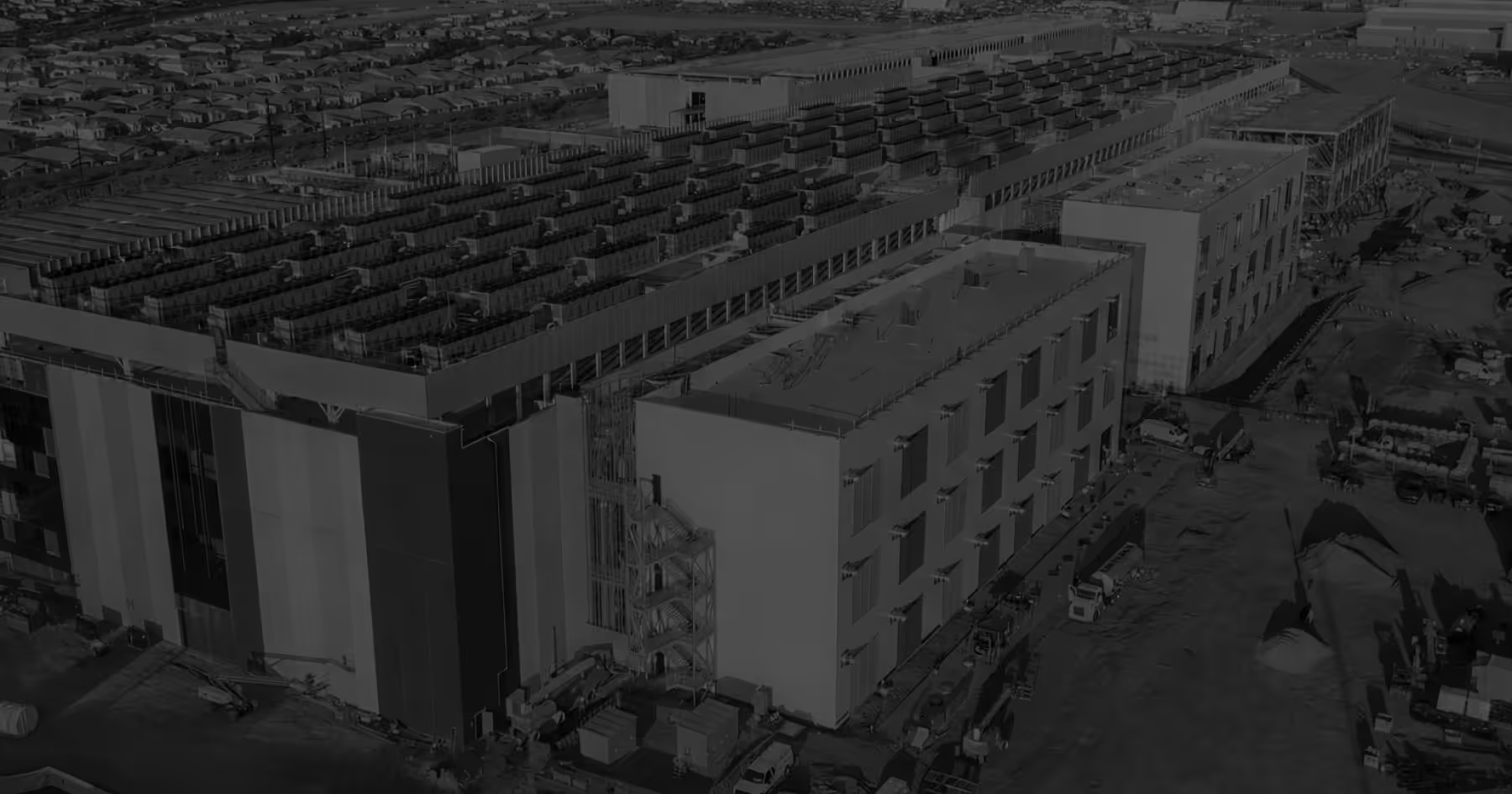
Given the manner in which the data center industry is evolving, flexibility has become increasingly important. Today, there is a keen focus on modular designs where infrastructure can be added in pre-assembled blocks, allowing providers to build faster and tenants to scale at their own pace. Flexibility is top-of-mind for forward-thinking providers, like EdgeCore Digital Infrastructure, that are developing large-scale, modular campuses engineered for density and long-term scalability in key markets, like Greater Phoenix and Northern Virginia.
Recent advancements underscore this need for scalable infrastructure:
- Nvidia's roadmap points to rack densities exceeding 300 kW by 2026 and surpassing 600 kW by 2027 with its Rubin Ultra platform.7
- Google's Project Deschutes introduces a 1 MW rack—made possible by direct-to-chip liquid cooling.8
These projections reinforce the need for high-density, AI-ready campuses.

Infrastructure Resiliency in the Spotlight
Modern data centers are being purpose-built to meet AI requirements, but resiliency is still top of mind. Redundant power pathways, advanced cooling systems, and multi-path network connectivity that support high-density workloads without disruption are the name of the game now.
At the same time, data center developers are rethinking their approach to efficiency. New campuses are integrating more sustainable technology, such as closed-loop water systems, high-efficiency mechanical designs, and modular buildouts that optimize performance from day one.
EdgeCore, for example, utilizes an air-cooled design in its data centers, including an ultra-efficient closed-loop chilled water system that requires nearly no water to recharge its effectiveness. This approach contributes to a water usage effectiveness (WUE) of 0.01 L/kWh—well below industry standards. These infrastructure choices support long-term operational continuity while minimizing environmental impact.
According to the RAND Corporation, infrastructure strategies like these are becoming increasingly critical to balance growing power demand with responsible energy use and environmental impact.3

Strategic Growth in Regional Markets
Due to the presence of available power and land, CBRE's 2024 report identifies Phoenix as one of North America's most active markets for new data center development, with record absorption and hyperscale-driven construction underway.6 EdgeCore recently announced the final development phase of its 450+ MW data center campus in Mesa, AZ following the acquisition of nearly 44 additional acres of adjacent land.
Greater Phoenix is becoming essential for supporting AI and cloud growth, offering the long-term scalability and infrastructure stability that modern workloads demand.

EdgeCore is building that future today. With recent land acquisitions, data center construction underway at six active sites, and high-density capacity coming online beginning in 2026, EdgeCore is building for what's next by continually pursuing the power, space, and connectivity needed to support AI and cloud innovation.
As customers shift toward more scalable, sustainable infrastructure, developers must focus on building facilities designed for high-density, hybrid workloads and long-term adaptability. Whether it's enabling next-gen AI deployments or supporting hybrid environments, EdgeCore is ready to power what's next.
Contact us today to secure space for your AI and hybrid workloads.
Sources
- The Network Installers – AI's Impact on Data Center Design (2024). thenetworkinstallers.com
- Goldman Sachs – AI to Drive 165% Increase in Data Center Power Demand by 2030 (2024). goldmansachs.com
- RAND Corporation – Navigating AI-Driven Energy Demands: Implications for U.S. Infrastructure Policy (2024). rand.org
- McKinsey & Company – AI Power: Expanding Data Center Capacity to Meet Growing Demand (2024). mckinsey.com
- Boston Consulting Group – Breaking Barriers to Data Center Growth (2025). bcg.com
- CBRE – North America Data Center Trends H1 2024. cbre.com
- Google Cloud Blog – Enabling 1 MW IT Racks and Liquid Cooling at OCP EMEA Summit (2024). cloud.google.com
- Data Center Dynamics – Jensen Huang: AI to Drive 600kW Racks by 2027 (2024). datacenterdynamics.com