
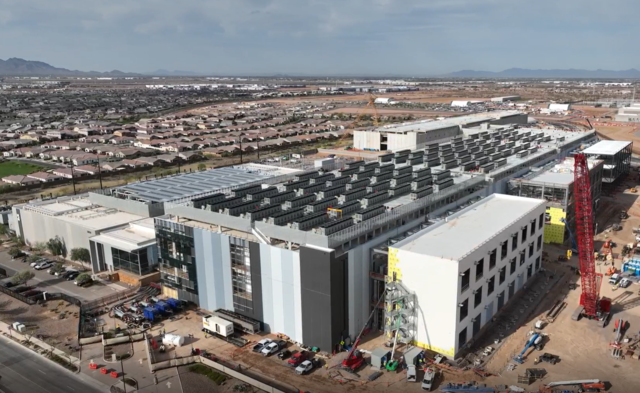
Construction activity at EdgeCore’s Phoenix data center campus in Mesa, AZ
AI’s explosive growth, combined with the demands of high-performance computing, is ushering in a new era of infrastructure design. As large language models (LLMs) expand into trillion-parameter territory, and enterprises deploy AI across real-time systems, the pressure on digital infrastructure is intensifying. What began as a compute problem has evolved into a comprehensive infrastructure transformation, spanning power delivery, thermal management, spatial planning, and network design.
Legacy enterprise and colocation environments were never engineered to support the scale, speed, or thermal complexity of modern AI workloads. Even traditional hyperscale sites must now adapt, retrofit, or rethink how they approach density and efficiency. Supporting modern AI workloads requires a complete architectural shift, making AI-ready data center infrastructure essential.
These new environments are purpose-built from the ground up: capable of hosting rack densities well over 50 kW, delivering 100+ MW of power to individual buildings, integrating advanced direct to chip liquid cooling systems, and connecting to key interconnection hubs with latency below 3 milliseconds.
EdgeCore Digital Infrastructure leads in this space, delivering campuses designed for density and built for AI.
Since 2019, the computing power behind AI (Nvidia GPUs) has grown at a staggering pace, doubling roughly every 10 months. That’s light speed compared to Moore’s Law, which historically had a two-year doubling cycle. We’re not only seeing bigger models, but also broader adoption across industries, more frequent training cycles, and dramatically increased deployment of production-level inference systems.
Model Training Demands
Training a cutting-edge foundation model is now a multi-month, multi-billion-dollar infrastructure effort. Meta’s Llama 4 Behemoth model is being trained on over 2 trillion parameters, 300 trillion tokens, and will require 520 trillion TFLOPs to train. New chips like Nvidia’s Blackwell Ultra GB300 and Rubin Ultra, support thousands of TFLOPs individually and are designed to be deployed in tens if not hundreds of thousands of scale-out GPU clusters across high-bandwidth fabric like NVLink and Infiniband.
Training environments can easily exceed:
These hardware and workload demands push infrastructure design to the bleeding edge, requiring custom electrical and mechanical topologies, advanced software-defined power management, complex tiered networking architectures, and facility-level integration with orchestration frameworks.
Explosive Inference Growth
Inference workloads are persistent and scale nonlinearly. Research included in EdgeCore’s blog Artificial Intelligence: The 2025 Changemaker projects that by 2027, AI inference demand will soar from under 50% of training workloads in 2022 to 400% by 2027.
Whereas training clusters can be isolated, inference clusters must be geographically distributed, latency-optimized, and capable of dynamically scaling based on traffic and usage patterns. This architectural shift demands AI data center infrastructure that can be deployed quickly, connected intelligently, and scaled without constraints. Furthermore, and perhaps most importantly, inference is where revenues are generated via practical applications, and in light of market questions about AI’s business viability has become the primary focus across the industry.
Scaling Laws and Compute Demands
As AI companies race toward larger, more intelligent models, they are also racing toward denser, more efficient compute infrastructure. The Chinchilla (DeepMind) and Kaplan (OpenAI) scaling laws both reinforce that model performance improves predictably with greater compute, incentivizing companies to:
This has catalyzed a global arms race for infrastructure. Leading cloud platforms and AI-native firms are locking in campus-scale developments in power-abundant, strategically located markets proximate to existing population centers and cloud regions—exactly the types of sites EdgeCore is bringing online in Arizona, Virginia, California, and Nevada.
Infrastructure Bottlenecks
Most legacy data centers were built to accommodate 10–15 kW rack densities and limited headroom for power or cooling upgrades. Retrofitting these environments for AI-scale deployments is:
In contrast, AI data center infrastructure like EdgeCore offers fungibility, modularity, parallelism, and phased expansion, giving customers the agility to evolve with model complexity and market demand—meeting the needs of AI training, AI inference, and/or traditional cloud.
EdgeCore has embraced an adaptable infrastructure model, designing each data center campus to support the intense demands of AI workloads while remaining flexible for broader cloud applications. Every site is developed with pre-secured land, power, fiber, and mechanical systems, therefore ready to accommodate high-density deployments across a range of customer use cases.
Traditional air-cooled systems for data centers that house AI workloads have reached the limits of their thermal efficiency. Enter Direct-to-Chip Liquid Cooling (DLC)—the new standard for high-performance AI workloads. DLC removes heat directly from the hottest point: the silicon die.
Until recently, DLC was confined to niche use cases in HPC environments. But in 2025, the industry is crossing a threshold: DLC is now entering mainstream production at hyperscale, accelerated by generative AI demand and shifting server specifications from leading hardware vendors like Nvidia.
“What looked ambitious in 2023 is the desired specification for supporting AI leading edge workloads in 2025 and will become the minimum specification for even denser GPU servers in 2026.”
— Tom Traugott, SVP Emerging Technologies, EdgeCore
As generative AI workloads scale, so do the physical and thermal requirements of GPU infrastructure:
These advances are only possible with direct-to-chip liquid cooling. DLC systems remove heat directly from the silicon die, enabling dense GPU configurations and allowing data centers to scale performance without thermal throttling.
EdgeCore’s AI data center infrastructure is designed with next-generation cooling in mind, including infrastructure to support direct-to-chip liquid cooling (DLC), liquid distribution integration, and high-efficiency containment strategies.
This shift is driving widespread adoption across hyperscale and enterprise environments. The global DLC market, valued at $1.85 billion in 2023, is projected to grow to $11.89 billion over the next decade, underscoring just how fast this thermal revolution is advancing.
AI’s power demands are fundamentally reshaping the design criteria for next-generation data centers. While colocation facilities were typically built to accommodate under 50 megawatts (MW) of power, that scale is no longer sufficient for today’s high-performance AI clusters. A single hyperscale AI deployment can demand over 300 IT MW, necessitating purpose-built solutions.
This section addresses how infrastructure planning differs at a high level and does not attempt to compare workloads in depth.
While AI model training can occur in isolated clusters—typically centralized in remote regions with abundant, low-cost power—inference workloads depend on proximity and responsiveness, since they must serve real-time applications like search engines, recommendation systems, and autonomous agents. Even a five-millisecond delay can disrupt real-time applications like voice assistants or recommendation engines. That’s why inference clusters must be located close to population centers and key interconnect points. As a result, inference infrastructure must be metro-adjacent, latency-optimized, and always-on.
For example, EdgeCore’s Culpeper, VA data center campus will connect directly into the high-density Northern Virginia fiber corridor, a key region for East Coast AI data center infrastructure. In the west, the Reno, NV campus will provide sub-three-millisecond proximity to the Bay Area’s AI ecosystem.
All of EdgeCore’s campus selections are equipped with redundant long-haul fiber routes, delivering low latency to major hyperscale hubs, and supporting high-speed interconnects for distributed inference clusters. This makes EdgeCore’s footprint ideal for real-time AI applications where data gravity, uptime, and proximity matter as much as power availability at scale.
The gap between traditional and AI data center infrastructure is growing wider—and fast. Many legacy operators cannot confidently support the mechanical, structural, or thermal demands of modern AI hardware. As hyperscalers and enterprise AI teams push toward higher rack densities and faster deployment timelines, these constraints are becoming more pronounced.
EdgeCore addresses this gap through a proactive development strategy. Each campus is pre-permitted and backed by secured power commitments. Sites like Phoenix and Reno are already being developed to support AI-centric growth, while EdgeCore’s future development in Culpeper, VA, underscores EdgeCore’s commitment to long-term scalability in secondary data center markets that have the right mix of land, power and connectivity.
As AI becomes a larger contributor to global energy consumption, data center providers are under growing pressure to deliver solutions that are not just powerful but also sustainable. Enterprises and hyperscalers alike are facing mounting ESG mandates, including net-zero targets, GHG emissions tracking, and energy use intensity (EUI) reduction commitments.
EdgeCore is actively rising to meet this challenge. Our designs are aligned with LEED and Green Globes standards, incorporating best-in-class principles for energy-efficient buildings.
Our sustainability commitment extends beyond the data hall. For example, through our partnership with SRP’s Dude Fire Restoration Initiative in Arizona, we’ve restored over 90 acres of forest, thereby improving watershed resilience and reducing wildfire-related carbon emissions. We’ve also implemented composting programs, built pollinator-friendly landscapes, and achieved a 55% waste diversion rate at our PH01 site.
The Shift from General-Purpose to AI-Specific Infrastructure
The infrastructure that powered cloud and enterprise computing in the last decade was never designed to support AI at scale. Data centers typically prioritize availability and cost efficiency for generalized workloads like email, databases, and virtual machines. But AI workloads operate on an entirely different power curve. They’re supercomputing environments, operating in larger coordinated blocks than before, compute-intensive, and heavily dependent on specialized silicon such as GPUs, TPUs, and custom AI accelerators.
This shift requires not just more power, but smarter power—at the scale, density, and reliability hyperscalers need to train and serve massive models continuously. General-purpose infrastructure falls short in its ability to deliver large blocks of megawatts, support multi-phased expansions, and react to highly variable compute demands. Hyperscalers need infrastructure designed explicitly to support AI-at-scale, not adapted after the fact.
The Reality of AI Power Demand
While a standard enterprise data center may operate at 10–50 MW, a single AI training cluster can require 30 times that, making AI-focused power planning essential.
Recent analysis from McKinsey, NVIDIA, and the International Energy Agency all point to AI consuming more than 3.5% of global electricity by 2030, with terawatt-scale demand becoming a serious planning scenario.
This kind of demand necessitates long-lead utility coordination, grid reinforcement, and next-gen electrical design. Hyperscalers aren’t simply looking for AI data center infrastructure—they’re looking for energy partners who can plan, permit, and deliver power years ahead of schedule.
Future Grid Challenges
Hyperscalers face a growing challenge: grid unpredictability and regional energy droughts. AI models will soon demand terawatt-scale energy consumption, leading to increased reliance on advanced power procurement strategies, microgrid integration, and longer term energy contracts.
How EdgeCore Meets These Needs
EdgeCore understands that power is not a commodity but a competitive differentiator. That’s why we pursue a proactive approach to power procurement and delivery, with three pillars guiding our strategy:
Why Cooling Matters
As AI accelerators continue to evolve, so too do their thermal requirements. Today’s GPUs and AI-specific silicon regularly exceed 700W per chip. Tam Dell’Oro, Founder of Dell’Oro Group, says, “AI workloads require significantly higher power densities, with rack power needs rising from an average of 15 kW today to between 60 kW and 120 kW in the near future. This shift is accelerating the industry-wide transition from air to liquid cooling.”
Without the right cooling systems in place, AI workloads throttle, performance degrades, and energy efficiency plummets. Worse, excessive heat can lead to hardware failures and prolonged downtime. For hyperscalers operating mission-critical AI clusters, the risks are simply too high. As a result, advanced cooling is now a must-have requirement.
What This Means for AI Infrastructure
The thermal characteristics of AI hardware require a fundamental rethinking of data center cooling strategy. Without proper heat dissipation:
To address this, liquid cooling is fast becoming the default strategy for hyperscale and AI data centers. The two dominant solutions—direct-to-chip liquid cooling (DLC) and immersion cooling—both provide superior heat transfer and unlock higher compute densities with reduced energy overhead.
In the race to support AI at scale, infrastructure maturity matters. Many providers are still retrofitting legacy environments—scrambling to install direct-to-chip liquid cooling or expand substation capacity years after the fact. EdgeCore took a different approach. From day one, our data centers have been designed explicitly for the power, cooling, and density demands of AI-first workloads.
Rather than adapting yesterday’s architecture for tomorrow’s needs, we engineered every component of our campuses, from mechanical systems to fiber pathways, for high-performance, high-density AI computing.
What sets us further apart is near-term availability. EdgeCore has already secured land and multi-phase power allocations in top-tier markets like Ashburn and Culpeper, Virginia, Phoenix, Silicon Valley, and Reno. This allows hyperscalers to scale immediately, without facing grid capacity delays or land entitlement risks.
And while our infrastructure is optimized for AI, it’s also flexible enough to support traditional cloud and enterprise workloads. This hybrid capability gives our customers deployment flexibility—whether they’re supporting mixed-mode environments or transitioning to an AI-first architecture over time.
Over the past five years, the computational requirements of AI workloads have grown by more than 1,000x. This exponential curve shows no signs of slowing. For hyperscalers, the ability to scale infrastructure is essential.
EdgeCore is ready for that future. Our campuses are engineered to support extreme power densities, efficient cooling evolution, and ultra-high-speed network performance—the foundational trifecta for any hyperscale AI deployment.
Significant Investments in AI-Centric Infrastructure
EdgeCore’s ability to deliver high-density, AI data center infrastructure at scale is funded, operational, and accelerating. Our roadmap is supported by multi-billion-dollar investments that reflect both market demand and investor confidence in the future of AI data center infrastructure.
In 2024, EdgeCore secured a $1.9 billion debt financing package, a foundational investment that directly supports the continued development of our flagship campus in Greater Phoenix. This funding enabled rapid land development, substation buildout, and multi-phase data hall construction to ensure capacity is not only planned but ready for activation.
Building on that momentum, EdgeCore announced a second major debt financing transaction later the same year. This round was strategically targeted to accelerate expansion in multiple markets and meet the rising demand for density-ready, AI-focused infrastructure. These proceeds are fueling critical upgrades, including direct-to-chip liquid cooling deployments, high-voltage switchgear installation, and campus-scale interconnection hubs.
Complementing these debt instruments, EdgeCore also closed a $1.9 billion equity investment, representing one of the largest private capital infusions in the data center sector. This capital is earmarked for long-term scalability, including land banking in emerging AI metros, securing multi-decade power entitlements, and building out the next generation of AI-first campuses.
Beyond physical sites, EdgeCore also supports the logical complexity of distributed AI systems. Whether it’s interlinking training clusters with edge inference, enabling federated model updates, or supporting burst-to-cloud strategies, our AI data center infrastructure is ready to support:
We see interconnection as part of the tech stack, not just a utility. In the AI-first era, compute is only as valuable as the speed at which it can communicate. At EdgeCore, we ensure that communication is always fast, direct, and future-proof.
The next generation of AI models will make current infrastructure look quaint. As model architectures shift to multi-modal, multi-agent, and continuous learning systems, data center design must anticipate even greater power densities, cooling sophistication, data movement throughput, and orchestration flexibility.
We’re entering an era where liquid cooling is the new standard. From rear-door heat exchangers to cold plate systems to full-system immersion, these technologies are being mainstreamed across hyperscale environments.
More importantly, data centers are being reimagined from the ground up for AI. This includes software-defined infrastructure, predictive capacity management, and real-time telemetry across power, cooling, and networking.
To meet these needs, EdgeCore is committing to the long-term arc of AI data center infrastructure.
AI Data Center Infrastructure Requires Long-Term Investment
EdgeCore is designing for the AI of 2035 and beyond, anticipating the infrastructure requirements of self-replicating model clusters, AI-first enterprise operations, and quantum-accelerated inference
This includes integrated planning around:
EdgeCore’s AI-first campuses are designed for what’s next. Whether you’re scaling a foundation model, deploying inference across regions, or future-proofing your infrastructure for what’s coming in 2035, EdgeCore delivers the power, flexibility, and vision to get you there.
Explore EdgeCore’s AI-First Data Centers and Build for the Future.